

Perfectionism is a Trauma Response: Overcoming High-Functioning Anxiety
Key Takeaways for Our Content:
- Connect perfectionism explicitly to trauma – Explain how perfectionism develops as a survival mechanism from childhood trauma/conditioning (none of the competitors do this clearly)
- Add the neuroscience angle – Explain brain chemistry of anxiety, control, and how psilocybin affects these pathways
- Focus heavily on “good enough” parenting – Specific section for mothers struggling with perfectionist parenting (major gap)
- Include the psilocybin “softening” effect – Unique angle: how plant medicine helps release need for control and perfectionism
- Emphasize women’s specific pressures – Society, motherhood, appearance, career expectations
- Provide somatic/body-based practices – Beyond cognitive approaches, include embodiment work
- Make it deeply personal and relatable – Balance authority with warmth and understanding
- Include community element – Unlike competitors, offer connection through Sugar Mama
You redo your child’s homework because their handwriting isn’t neat enough. You stay up past midnight cleaning the house even though you’re exhausted. Everything must look perfect on the outside, even when you’re falling apart inside. This isn’t just about being organized or caring about quality. This is perfectionism, and for many women, it’s actually a trauma response disguised as ambition.
Perfectionism feels like it’s about standards, but it’s really about survival. At some point, you learned that being perfect kept you safe, loved, or accepted. Maybe mistakes meant punishment, criticism, or withdrawal of affection. Your brain recorded the message: perfect equals safe, imperfect equals danger. Now you can’t stop, even when the original threat is long gone. Healing from trauma means learning that good enough is actually good enough.
Understanding Perfectionism as a Trauma Response

What Trauma Really Means
Trauma isn’t just big, terrible events like abuse or accidents. Trauma includes any experience where you felt unsafe, unseen, or not good enough as you were. Growing up with constant criticism creates trauma. Having parents who only showed love when you achieved creates trauma. Being compared to siblings or peers creates trauma. Your nervous system doesn’t need a single dramatic event to learn that you must be perfect to be safe.
Many women don’t recognize their perfectionism as trauma-related because they think trauma requires something obviously bad to have happened. But developmental trauma happens when your needs for unconditional love, safety, and acceptance weren’t consistently met. If you had to earn love through performance, your brain wired itself for perfectionism as protection.
How Your Brain Learns Perfectionism
When you were young and made a mistake, what happened? If caregivers responded with anger, disappointment, or withdrawal, your amygdala (fear center) recorded that mistakes equal danger. Your brain started working overtime to prevent mistakes. This hypervigilance became automatic. Even now, decades later, the thought of imperfection triggers the same fear response as actual danger.
Your prefrontal cortex (thinking brain) knows logically that your worth isn’t tied to performance. But trauma doesn’t live in the logical brain. It lives in the nervous system and the emotional brain. That’s why you can’t just “think” your way out of perfectionism. You need approaches that work with your whole nervous system, not just your thoughts.
The High Functioning Anxiety Connection
Perfectionism and high-functioning anxiety are two sides of the same coin. High-functioning anxiety means you appear successful and capable while internally drowning in worry, self-doubt, and fear of failure. You push through exhaustion. You say yes when you want to say no. You maintain a polished exterior while privately struggling with panic attacks, insomnia, and physical tension.
Society rewards high-functioning anxiety. Your boss loves that you’re always early, never miss deadlines, and produce flawless work. Friends admire how you manage everything so gracefully. But this constant performance is exhausting. Your nervous system stays in fight-or-flight mode 24/7. The validation you receive for perfectionist behavior reinforces the trauma pattern even as it slowly burns you out.
Why Women Struggle More with Perfectionism
Society’s Impossible Standards
Women face perfectionist pressures that men simply don’t experience at the same level. You’re expected to have a successful career but also be the primary parent. Your body should bounce back after pregnancy while you’re sleep-deprived and healing. Your home should look magazine-perfect while you work full-time. You should be nurturing but not too emotional, ambitious but not threatening, confident but not arrogant.
These contradictory expectations create an impossible bind. No matter what you do, you’re failing someone’s standard. So you try harder. You wake up earlier. You schedule every minute. You optimize everything from meal prep to your morning routine. But the goalpost keeps moving because the game itself is rigged.
The Mother Wound and Perfectionism
Many women’s perfectionism traces back to their relationships with their own mothers. If your mother was critical, you learned you had to be perfect to be loved. If your mother was herself a perfectionist, you absorbed that anxiety about measuring up. Even if your mother was warm and loving, societal pressure on her may have leaked into messages you received about needing to be more, do more, and achieve more.
The mother wound isn’t about blaming moms. Most mothers did their best with the resources and awareness they had. It’s about recognizing patterns that got passed down through generations of women taught that their value comes from perfection, selflessness, and meeting everyone else’s needs before their own.
Perfectionist Parenting Pressure
Nowhere does perfectionism show up more than in motherhood. You research the “right” way to feed your baby, sleep train, discipline, educate, and schedule. You compare yourself to other mothers who seem to do it all effortlessly. You feel guilty for every imperfect parenting moment, every time you lose patience, every choice that might not be optimal.
Social media amplifies this pressure. You see curated glimpses of perfect mothers with perfect children in perfect homes. You don’t see the tantrums, the burnout, the mess behind the filtered photo. You judge yourself harshly for not measuring up to an impossible fiction. Your children feel the tension of your perfectionism even when you think you’re hiding it well.
The Real Cost of Perfectionism
Physical Health Consequences
Chronic stress from perfectionism damages your body. Cortisol (stress hormone) stays elevated, suppressing your immune system and contributing to inflammation. You might experience headaches, digestive issues, muscle tension, or chronic pain. Sleep suffers because your mind won’t stop reviewing what you did wrong and planning how to be better tomorrow.
Many women with perfectionism develop hormonal imbalances because constant stress disrupts the delicate balance of estrogen, progesterone, and cortisol. Your period might become irregular. Your libido disappears. You feel exhausted but can’t rest because there’s always more to do to maintain the illusion of having it all together.
Mental and Emotional Toll
Perfectionism creates a constant background hum of anxiety. You ruminate about past mistakes and worry about future failures. Decision-making becomes paralyzed because you fear choosing wrong. You might procrastinate on important projects because if you can’t do them perfectly, why start? Or you overwork, pouring excessive time into tasks that don’t warrant it.
Depression often accompanies perfectionism. When you can never measure up to your own impossible standards, you feel like a failure despite external success. Accomplishments feel hollow because you immediately focus on what could have been better. This chronic dissatisfaction steals your ability to feel joy, pride, or contentment.
Relationship Damage
Perfectionism pushes people away, even as you desperately want connection. You might hold others to the same impossible standards you hold yourself. You get frustrated when partners, friends, or children don’t meet your expectations. Or you present a perfect facade that prevents authentic intimacy because you’re terrified of being seen as flawed.
In romantic relationships, perfectionism can manifest as difficulty being vulnerable. You fear that if your partner saw your messy, imperfect reality, they’d leave. So you keep performing, which is exhausting and lonely. True intimacy requires imperfection, messiness, and being seen in your humanity.
The Neuroscience of Letting Go
Your Brain on Perfectionism
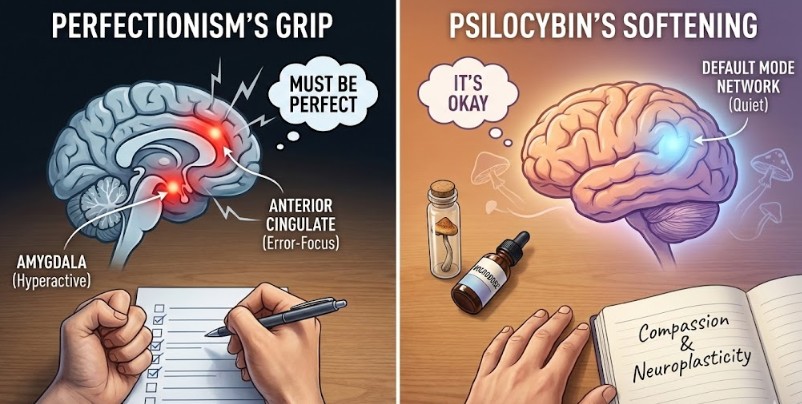
Perfectionism involves specific brain patterns. Your amygdala stays hyperactive, constantly scanning for threats (mistakes, imperfections, judgment). Your anterior cingulate cortex (the part that notices errors) fires excessively. Meanwhile, your ventral striatum (reward center) struggles to experience satisfaction because nothing is ever good enough.
This creates a vicious cycle. High anxiety from amygdala activation makes mistakes more likely. When mistakes happen, you criticize yourself harshly, further activating stress pathways. The reward you get from achieving perfection is fleeting because your brain immediately shifts to the next thing that needs to be perfect.
How Psilocybin Offers a Different Way
Psilocybin, the active compound in magic mushrooms, affects your brain in ways that directly counter perfectionist patterns. It binds to serotonin 2A receptors, reducing activity in the default mode network—the brain area responsible for rumination, self-criticism, and rigid thinking patterns. When this network quiets, you can see yourself and your life from a softer, more compassionate perspective.
Research shows psilocybin increases neuroplasticity, meaning your brain can form new connections and break old patterns more easily. For perfectionists, this translates to loosening the grip of “must,” “should,” and “have to.” Thoughts that usually feel like absolute truth (“I have to get this right or terrible things will happen”) become just thoughts—mental events you can observe without believing.
The Softening Effect
Women who microdose psilocybin for perfectionism often describe a “softening” that happens over time. The sharp edges of self-judgment become less cutting. The constant pressure to perform eases slightly. You might notice yourself making a mistake, and instead of spiraling into shame, you just shrug and move on. This isn’t about not caring. It’s about finding the middle ground between carelessness and exhausting perfectionism.
The softening extends to how you see others, too. If you’ve been judgmental of people who seem less disciplined or accomplished, psilocybin can help you access empathy. You start to see that everyone is doing their best with what they have. This shift in perspective on others naturally extends to more self-compassion, too.
Embracing Good Enough Parenting
What Good Enough Actually Means
“Good enough” parenting is a concept from psychologist Donald Winnicott. It means your child doesn’t need you to be perfect. In fact, they need you to be imperfect, so they learn that mistakes are part of being human. Good enough means meeting your child’s needs most of the time while also being a real person with limits, feelings, and flaws.
Perfectionist parents often think good enough sounds like lowering standards or not caring. But it’s actually about appropriate standards. Your child needs food, safety, love, and presence. They don’t need organic homemade baby food, a spotless house, perfect behavior, or a Pinterest-worthy childhood. When you chase perfection, you’re often meeting your own anxiety needs, not your child’s actual needs.
Your Children Need Your Humanity
When you model perfectionism, your children learn that mistakes are shameful and that they must hide their struggles. They internalize the message that they’re only lovable when performing well. This sets them up for their own perfectionism and anxiety. The greatest gift you can give your kids is showing them that adults make mistakes, feel stressed, apologize, and try again.
Your children benefit more from a relaxed, present parent than a perfect, stressed one. Think about your own childhood memories. The ones that feel warm probably aren’t about having a perfect mom. They’re about moments of connection, laughter, and feeling safe. Your kids will remember how you made them feel, not whether the house was clean.
Releasing Control in Motherhood
Perfectionist parenting is really about trying to control outcomes through sheer force of will. If you do everything “right,” surely your child will turn out well-adjusted, successful, and happy. But children are separate people with their own temperaments, struggles, and paths. Your job is to provide love and guidance, not to guarantee outcomes.
Microdosing can support this release of control. Many mothers report that small doses help them relax into parenting instead of micromanaging. They can tolerate their child’s disappointment without rushing to fix it. They can let their teenager make mistakes without catastrophizing. This doesn’t mean checking out. It means trusting the process instead of trying to control every variable.
Practical Steps to Heal Perfectionism
Notice Your Patterns Without Judgment
Start by simply observing when perfectionism shows up. What situations trigger it? Is it work presentations, your appearance, your home, or your parenting? Notice the physical sensations that accompany perfectionist anxiety—tight chest, racing thoughts, stomach churning. Just observe without trying to change anything yet.
Keep a journal tracking perfectionist moments. Write down what happened, what you felt, and what fear was underneath. Often, perfectionism is protecting you from a deeper fear—rejection, abandonment, being seen as incompetent. When you understand the fear, you can address it directly instead of just battling symptoms.
Practice B-Minus Work
This exercise comes from productivity expert Tim Ferriss. Intentionally do something at B-minus quality when your perfectionism would demand an A-plus. Send an email with a small typo. Leave the house with mismatched socks. Submit work that’s good enough instead of polished to perfection. Notice what happens. Usually, nothing bad happens at all.
Start small with low-stakes situations. As you build evidence that imperfection doesn’t lead to catastrophe, you can try it in bigger areas. The goal isn’t to stop caring or doing quality work. It’s to calibrate your effort to match what the situation actually requires instead of pouring excessive energy into everything.
Talk Back to Your Inner Critic
That harsh voice judging everything you do isn’t the voice of truth. It’s the voice of old trauma trying to keep you safe through perfection. When you notice self-criticism, pause. Thank the voice for trying to protect you, then consciously choose a different response. What would you say to a friend in this situation? Say that to yourself instead.
This feels weird at first because that critical voice has been running the show for so long. But with practice, you can build a new inner voice—one that’s firm but kind, honest but gentle. Self-compassion practices strengthen this kinder internal dialogue.
Set Better Boundaries
Perfectionism often comes with difficulty saying no. You take on too much because you want to be helpful, capable, and indispensable. But this leads to burnout and resentment. Practice setting boundaries by declining requests that don’t align with your values or capacity. You don’t need an elaborate excuse. “I’m not available for that” is a complete sentence.
Start by identifying your non-negotiables—the things that matter most to your wellbeing and values. Protect time for rest, creative pursuits, and relationships. Everything else can be evaluated based on whether it serves your priorities. This might mean your house is messier, or you participate in fewer activities. That’s okay.
Build Body Connection
Perfectionism lives in your head, constantly planning and worrying. Building a connection with your body helps interrupt those patterns. Try gentle movement like yoga, dance, or walking in nature. Notice sensations without judgment. Where do you feel tension? What happens when you breathe deeply into tight areas?
Somatic practices help release trauma stored in your body. This might include shaking, sound, or other forms of physical release. When you befriend your body instead of treating it as another thing to perfect, you access wisdom that helps you relax into being human.
Plant Medicine Support for Releasing Perfectionism
How Microdosing Helps Daily Life
Microdosing psilocybin means taking very small amounts (typically 100-300mg of dried mushrooms) on a regular schedule. The dose is sub-perceptual—you don’t hallucinate or feel “high.” Instead, many people notice subtle shifts in perspective, mood, and mental flexibility. For perfectionists, these shifts can be game-changing.
On microdose days, you might find yourself less reactive to small imperfections. A spilled cup of coffee feels annoying but not catastrophic. Your child’s tantrum triggers compassion instead of shame about your parenting. Tasks feel lighter because you’re not carrying the weight of needing them to be perfect.
Combining Microdosing with Intentional Practice
Psilocybin isn’t magic that fixes perfectionism overnight. It’s a tool that works best when paired with conscious practice. Use microdose days to work on letting go. Try that B-minus work. Practice saying no. Notice your inner critic and choose self-compassion. The medicine creates openings; you do the work of stepping through them.
Many women use a monthly rhythm—microdosing one week, then integrating lessons the rest of the month. This creates a pattern of opening (with medicine support) and grounding (applying insights to daily life). Over time, the new patterns become more automatic even without medicine.
Deeper Work with Higher Doses
While microdosing offers gentle daily support, some women find that occasional higher doses in a safe, intentional setting help them access and release deeper layers of perfectionist trauma. A guided session with clear intention can surface childhood memories, release stored emotion, and shift perspective in ways that months of therapy might not achieve.
If you’re considering this approach, preparation and integration matter as much as the experience itself. Set a clear intention around releasing perfectionism. Create a safe space. Have support during and after the experience. Journal about insights. Work with the material that surfaces. This isn’t about escaping your perfectionism for a few hours. It’s about fundamentally changing your relationship with it.
Tools to Support Your Healing

Gentle Daily Practices
Our capsules offer a precise, convenient way to microdose as part of your healing practice. Many women prefer the consistency and ease of knowing exactly what dose they’re taking each time. Starting small allows you to notice how psilocybin affects your particular perfectionist patterns without overwhelming your system.
Options for Different Needs
For those who want to make the practice more enjoyable, our chocolate bars deliver the same benefits in a form that feels like self-care rather than medicine. Taking your dose can become a ritual of intention-setting—a moment where you consciously choose to practice softening your perfectionist grip.
Some days call for something light and easy. Our gummies provide consistent microdoses in a convenient form that’s simple to take on busy mornings. For women ready to work with slightly higher doses for deeper release, our 500mg gummies offer that option while still being approachable and precisely measured.
The key is finding what works for your life and your healing process. There’s no one right way to work with plant medicine for perfectionism. Some women microdose daily, others a few times per week. Some prefer structure and routine, others intuitive dosing. The medicine meets you where you are.
Finding Your Community
Why Healing Happens in Connection
Perfectionism thrives in isolation. When you believe you’re the only one struggling, when you can’t show anyone your messy reality, the perfectionist patterns strengthen. Healing happens when you connect with others who understand your struggle. Being seen in your imperfection and still accepted breaks the core wound that perfectionism protects.
The Sugar Mama program offers exactly this kind of connection. You’ll find women working through similar perfectionist patterns, releasing control in motherhood, and learning that good enough is actually enough. This isn’t about comparing who’s further along in healing. It’s about supporting each other through the messy, nonlinear process of becoming more human.
Building Real Relationships
In the community, you practice being imperfect in real-time. You might share a struggle and notice you’re not judged. You might see another woman’s vulnerability and realize her imperfection makes you feel closer to her, not less respectful. These experiences contradict the perfectionist belief that you must hide your flaws to be acceptable.
The community also provides practical support. When you’re tempted to overdo something, someone can gently remind you that good enough is okay. When you’re being hard on yourself, someone can offer compassion. You should stop shouldering everything alone, which itself is an act of releasing perfectionist control.
Living Beyond Perfectionism
What Freedom Actually Feels Like
As you heal perfectionism, you’ll notice shifts that feel strange at first. You might leave dishes in the sink overnight and feel okay about it. You might send your kid to school in wrinkled clothes and not spiral with shame. You might make a mistake at work and just fix it instead of beating yourself up for days.
This freedom doesn’t mean you stop caring or trying. It means your worth isn’t on the line with every decision and action. You can care deeply about your work, parenting, and life while also knowing that imperfection doesn’t threaten your value. You become more focused on what actually matters instead of trying to perfect everything.
Trusting the Process
Healing perfectionism is not linear. You’ll have days where the old patterns feel overwhelming again. You’ll catch yourself spiraling into self-criticism or overworking. This doesn’t mean you’ve failed or lost progress. It means you’re human. Each time you notice the pattern and choose differently—even just 10% differently—you’re rewiring your nervous system.
Trust that the softening happens gradually. Small shifts compound over time. One day, you realize you haven’t criticized yourself in hours. Another day, you delegate something you used to insist on controlling. These moments of grace add up to a fundamentally different way of being.
Creating Your New Normal
Eventually, good enough becomes your new standard. Not because you lowered your standards, but because you recalibrated them to reality. You do work you’re proud of without pouring excessive perfection into it. You parent with love and presence without trying to control every outcome. You show up in relationships as your real, imperfect self.
This new normal feels lighter. You have energy for things that matter because you’re not depleting yourself, maintaining an impossible facade. You laugh more. You rest without guilt. You make mistakes and recover quickly. This is what living beyond trauma looks like. This is freedom.
Your Next Steps in Healing
Perfectionism is a trauma response, but it doesn’t have to be your forever response. You can retrain your nervous system to know that safety doesn’t require perfection. You can learn that good enough is actually more than enough. Your children, your relationships, and your own well-being will thank you for this work.
Start small. Pick one area where you’ll practice B-minus work this week. Notice your inner critic without believing everything it says. Consider how microdosing support might help soften the grip of perfectionist anxiety. Connect with others doing similar work. Most importantly, be patient and compassionate with yourself through this process.
You didn’t develop perfectionism overnight, and you won’t heal it overnight either. But every moment you choose self-compassion over self-criticism, every time you let something be good enough, every instance of releasing control—these are acts of profound healing. You’re not just changing behavior. You’re rewiring patterns laid down in childhood. You’re breaking generational cycles. You’re becoming free.
Frequently Asked Questions About Perfectionism and Trauma
How do I know if my perfectionism is actually a trauma response?
Ask yourself: When did perfectionism start? What happened when you made mistakes as a child? Did love and acceptance feel conditional on performance? If your perfectionism developed as a way to feel safe, loved, or valued, it’s likely trauma-related. Other signs include intense fear of mistakes, shame spirals after imperfection, and feeling like your worth depends on achievement.
Can microdosing really help with perfectionism?
Microdosing psilocybin affects brain areas involved in rumination, rigid thinking, and self-criticism. Many people report that small doses help them gain perspective on perfectionist thoughts without getting swept away by them. The medicine creates space between “I made a mistake” and “I’m a terrible person,” allowing for more compassionate responses. It’s not a magic fix, but it can significantly support healing work.
How can I stop being a perfectionist parent without becoming a neglectful one?
Good enough parenting isn’t about lowering standards or not caring. It’s about appropriate standards. Your child needs consistent love, safety, and presence more than they need perfect performance from you. Focus on emotional attunement over perfect outcomes. Let them see you make mistakes and model recovery. This actually prepares them better for life than trying to provide a flawless childhood.
Will letting go of perfectionism make me less successful?
Most people find they become more effective when they release perfectionism because they’re not paralyzed by fear of imperfection. You’ll still do quality work, but without the exhausting over-polishing that perfectionism demands. Plus, you’ll have energy for what actually matters instead of spreading yourself thin trying to perfect everything. Success built on sustainable effort lasts longer than success powered by anxiety.
Begin Your Softening Journey
Ready to release the perfectionist grip and find your way to good enough? Our capsules provide consistent microdose support for daily healing. Prefer something that feels indulgent? Try our chocolate bars for a dose that doubles as self-care. Want quick and easy? Our gummies deliver reliable doses in a convenient form. For deeper work, explore our 500mg gummies paired with intentional practice. And join us in Sugar Mama to connect with women releasing perfectionism together. Get support, share your journey, and discover that your imperfection is exactly what makes you beautifully human. Freedom from perfectionism starts with one small choice to be a little easier on yourself today.