
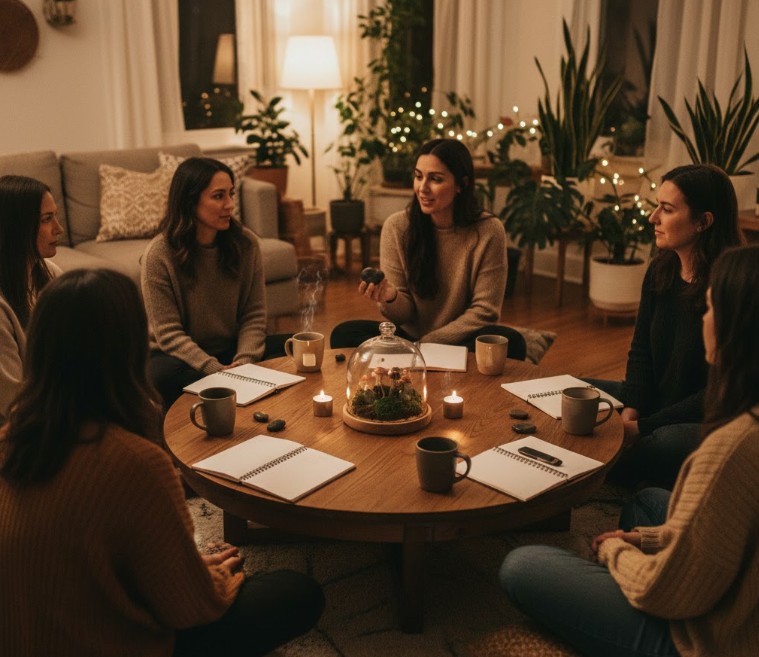
Hosting Your Own Women’s Circle: A Starter Guide
Hosting a women’s circle can feel bold and a little scary because you are setting the pace and holding the room when real feelings show up. Still, you do not need a perfect home or fancy tools, just a clear plan that keeps everyone heard.
If you’ve been searching for how to host a women’s circle, this starter guide gives you a simple flow, kind rules, and ways to handle hard moments without panic. You’ll also get women’s circle ideas and prompts you can reuse, plus a soft product moment near the end, so the circle stays people-first.
What a women’s circle is
A women’s circle is a small group that sits in a circle and shares, one person at a time, while everyone else listens without jumping in. It can be light and fun, or quiet and tender, but it stays respectful.
Most circles use a theme, a short opening, a share round, and a close, so the night has a clear form and nobody feels lost. If you like ritual, borrow a simple idea from daily rituals.
What a women’s circle is not
A circle is not therapy, and it is not a place to diagnose, label, or pressure someone to share more than she wants. If someone needs more care than a circle can give, encourage her to reach out to a licensed therapist.
A circle is also not a place for gossip, recording, or retelling someone’s story outside the room, even if you mean well. Privacy is the base layer that lets women speak in a real way.
How to host a women’s circle with a simple plan

Start by choosing your “why” for the night, because a clear why keeps the talk from turning into random catching up. Your why can be rest, boundaries, friendship, or “what I need this month.”
Next, choose the group size, the date, and the place, then write the invite with the rules in one short section. When women know what to expect, they show up calmer, and they share more.
Keep your first circle small, because a small group is easier to guide, and it leaves room for everyone to talk without rushing. Four to eight women is a sweet spot for a first night.
If more people want to come, set a second date right away, or split into two circles, so nobody feels pushed out. A waitlist is fine, but a second date feels more welcoming than “maybe later.”
Pick one focus for the night
A focus makes hosting easier, because you can pick prompts, music, and a close that all match one simple theme. It also helps guests show up with the right headspace.
For an easy first focus, try “what I need more of right now,” because it invites honest sharing without pulling the room into heavy stories too fast. You can also use “one win, one worry, one wish” to keep shares balanced.
If your circle loves routine and small habits, a ritual theme works well because it feels practical and calming at the same time. For follow-up reading, share self-care rituals after the circle.
Choose who to invite
Invite women who can listen without correcting, teasing, or taking over, because the first circle sets the tone for every circle after it. If there is old tension, keep the list smaller.
If you are hosting friends who do not know each other, start with a lighter theme and shorter shares, so trust can build without pressure. You can also ask everyone to arrive ten minutes early for tea.
If you are part of Sugar Mama, inviting other ambassadors can feel natural because you already share a vibe and a shared interest. Make it clear that nobody has to buy anything to belong.
If you want to open the circle to new faces, ask each returning guest to bring one friend she trusts, so the group grows slowly and stays kind. Big shifts in the guest list can make shy women go quiet.
Choose a space that feels private
A circle can happen in a living room, a backyard, or a quiet rented room, as long as the space feels private enough for real talk. Pick a place where you will not be interrupted.
Set chairs in a true circle, not in rows, so faces are easy to see, and nobody feels left out. If you offer floor pillows, keep chairs too, because comfort helps people stay present.
Before guests arrive, set out water, tissues, and a simple snack, because hunger and dry mouths can make people edgy. Ask about allergies in advance, and keep food clean and not messy.
Use soft lamps instead of harsh overhead lights, because light can shift the mood fast and can make nervous people feel exposed. If you use candles, keep them stable, and ask first if the scent is okay.
Pick a date and time that repeats
Repeating dates save you from endless planning texts, because people can plan, and the circle becomes part of the month. Try the first Sunday or the third Thursday, and stick to it.
For a first circle, ninety minutes is enough time for an opening, one share round, and a close without tiring everyone out. Two hours can work later, once the group respects the clock.
Start on time, even if a few women are late, because late starts teach the group that timing does not matter. End on time, because that makes it easier for women to say yes again.
Write an invite that sets expectations
A good invite is short, clear, and kind, and it tells women what to bring and what to expect in plain words. Include date, time, place, theme, and one line that says “you can pass.”
Add one line about privacy, so women know stories will not be shared outside the room, and no one will be recorded. If you plan a group chat, ask before adding anyone.
If you want a simple script, keep it like this: “We’ll open, share, and close, and we’ll listen without interrupting.” A script lowers fear, because women know the plan before they arrive.
Circle rules that keep the room kind
Rules keep the circle fair because they stop side talk and they make time feel evenly shared. Three rules work well for most circles: speak from “I,” no interrupting, and privacy.
A “no fixing” rule helps a lot, because advice can land like judgment, even when it is meant as love. If someone wants ideas, she can ask at the end, and then the group can share.
Consent matters in a circle, and it includes touch, advice, and how you respond to a story. Ask before hugging, ask before giving advice, and ask before sharing someone else’s story in a different setting.
Phones pull attention away from the room, so ask everyone to silence phones and keep them face down or in a basket by the door. If someone needs to be reachable for kids, agree on a plan.
If your group tends to interrupt, use a speaking piece, so only the person holding it speaks while others listen. A stone, shell, or small object works, and it gives nervous hands something to hold.
A flow you can reuse every time
A repeatable flow makes hosting easier because you are not inventing the night on the spot or guessing what comes next. Use four parts: opening, check-in, share round, and closing.
Keep the opening short, because long readings can feel like a lecture and can make people tune out. A candle and one shared breath are enough to signal “we are starting now.”
For check-in, use a one-word round or a short line like “today I feel,” because it helps women arrive without pressure. Then tell the group what comes next, so the room stays steady.
For the share round, use one prompt and let each woman speak without being cut off, even if her share is messy. If time allows, offer a second round where women can add one more thought.
Plan a five-minute break in longer circles, because bodies need water, bathrooms, and a reset when feelings run high. Play music during the break, and keep it quiet during shares.
For closing, do a one-word round again, thank everyone, and repeat the privacy rule one more time before women stand up. A clear close helps people leave feeling settled.
Women’s circle ideas for themes that work
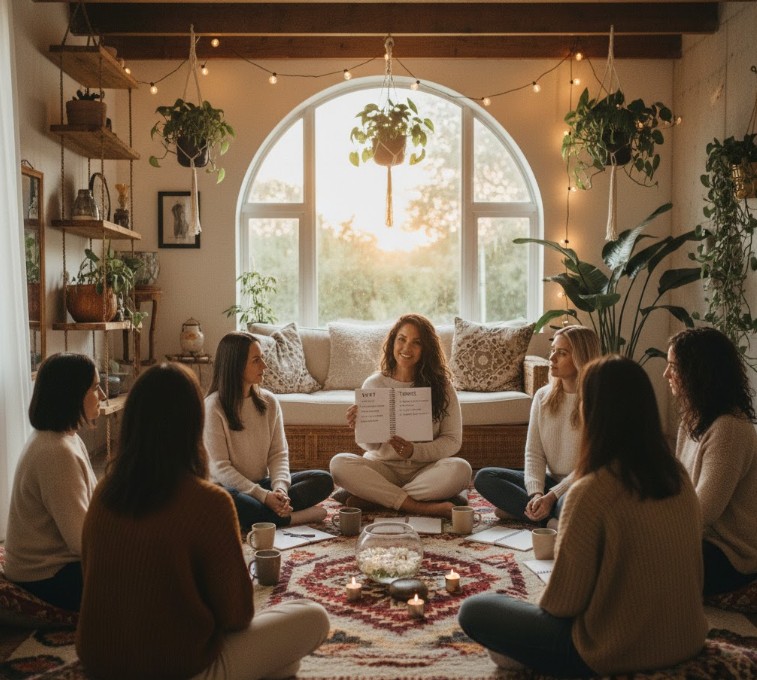
When you want women’s circle ideas, start with themes that match real weeks, like rest, stress, self-trust, or friendship. A theme that fits daily schedules keeps the talk grounded.
For a restful night, ask “what keeps me up” and “what helps me settle,” then let each woman name one small habit to try. For follow-up reading, share sleep.
For a self-care night, ask “what drains me” and “what fills me,” then keep the first round short so nobody feels put on the spot. Later, share self-care.
For a friendship night, ask “where do I want to show up more” and “what do I want to ask for,” then leave silence after each share. After the circle, share friends.
For a boundaries night, ask “where do I say yes too fast” and “what is one no I need to practice,” then keep the tone gentle and practical. Remind the group that boundaries are care.
For an intentional night, ask “what do I want more of” and “what is one small action I will try this week,” then close with one word. If you want a seasonal tie-in, share new rituals.
Prompt ideas that make sharing easy
Prompts work best when they invite stories, not debates, and when they can be answered in plain words without a long backstory. Keep prompts short and print them, so you do not ramble.
Try prompt starters like “right now I need,” “right now I’m proud of,” “right now I’m letting go,” and “right now I’m learning.” For more options, use prompts and pick five that match your theme.
If your group is shy, begin with “one small win,” because it feels safe and warm, and it sets a friendly tone. After that round, offer a second prompt that feels a bit more personal.
If your group is very talkative, use a timer and name it kindly, like “I’m watching the clock so everyone gets time.” A timer feels fair, and it keeps one person from taking the whole room.
If someone does not want to share, let her pass without questions, because pressure breaks trust fast and can make women stop coming. Over time, many women share more when passing is normal.
Playlist and mood
Music can calm nerves, but lyrics can pull focus away from shares, so pick soft instrumentals or gentle ambient tracks. Make one playlist that runs longer than your circle, so you do not touch your phone.
Keep volume low during shares, and raise it slightly during breaks, so the room can breathe without becoming noisy. If your group loves silence, skip music during shares and use it only for opening.
A simple playlist plan is three parts: soft start, steady middle, and calm close, with only a few songs swapped each month. A familiar sound can help shy guests settle faster.
If you want a ritual tie-in, share the microdosing ritual after the circle, because it talks about routine and small practices. Even if nobody is dosing, the ritual framing can still fit.
How to hold the room with care
Silence can feel awkward, but it is often the moment when someone decides to be honest, so do not rush to fill it. Count to five in your head, and let the room breathe.
If someone cries, stay calm, offer water, and let her take a breath before you speak, because fast words can feel like pressure. You can ask, “Do you want a pause?” and accept her answer.
If someone feels flooded, invite her to plant her feet on the floor and take a slow breath, then ask if she wants to step out. Ask one trusted friend to go with her, so she is not alone.
If a share points to danger, abuse, or self-harm, pause the circle and get outside care right away, because that is bigger than a share night. You can keep it simple and say, “We’re going to get help now.”
If conflict shows up, pause and restate the rules, then hand the floor back to the person who was sharing, so the room stays fair. If someone keeps interrupting, use the speaking piece and the timer.
If one person talks too long, set a time limit at the start and keep it the same for everyone, so it feels fair and not personal. You can offer a second round for longer shares if time allows.
If someone advises without being asked, thank her for caring and bring the room back to listening, because advice can shut other women down. You can say, “Let’s hold advice for the end.”
If you are hosting alone, keep a simple “hard moment” plan in your head, like where someone can sit, where water is, and who can drive. Planning that in advance helps you stay calm in the moment.
Hosting online without losing warmth
Online circles work well when friends live far apart, but video calls tire people faster than in-person nights, so keep the group smaller. Six or fewer is a good start.
Ask women to join from a private room with headphones, so they can speak without being overheard at home. Ask everyone to close other tabs and silence notifications.
Use the same flow as in person, but keep shares shorter and add a pause every twenty minutes, because screens drain energy. End with a clear close, because hanging up can feel abrupt.
If you use music online, keep it very low or skip it, because audio lag can distract and break the mood. A shared breath can replace music and still mark the start.
If your circle includes microdosing talk
Some circles never mention mushrooms, and that is fine, because the circle is about listening and honest shares, not one topic. If your group wants mushroom talk, keep it educational and pressure-free.
Begin with basics from mushrooms 101, then keep the talk on routine, mood, and daily habits, not big stories. Remind the group that laws differ by place.
If women ask about forms, point them to forms and keep the circle talk on what feels practical for daily schedules. Ask a share question like “What do I want more of?”
If women ask about dose talk, share dosage, and remind them that slow starts often feel better than big jumps. In the circle, keep numbers optional, so nobody feels judged.
Set and setting still matter for small doses, since a stressful day can color how a person feels, even with a small amount. Share the set and setting and keep it about space and planning.
If your group wants a calm practice to pair with the night, share meditation and invite women to try it once during the week. For better words with family, share talking.
If someone has a medical condition or takes meds, tell her to talk with a licensed clinician before trying any substance, because safety comes first. That keeps you from playing doctor, and it keeps the circle ethical.
A natural product moment at the end
If your group already knows My Sugar Magnolia, you can share products at the end without pressure by naming what each form fits best for the daily routine. For easy daily use, link capsules.
If someone likes a treat from you, share chocolate and keep your words simple and kind, with no hype. If someone likes bite-sized, share gummies, and suggests tracking sleep and mood.
If someone prefers a stronger piece to split, share 500mg gummies and remind her that smaller pieces can feel easier than a full one. Never make anyone feel like she needs a product to belong.
If you want to host circles as a brand partner, join Sugar Mama and meet other women who love ritual and real talk. For posting tips that still respect privacy, share on social media.
FAQs
How do I host a women’s circle for the first time?
Pick one theme, invite four to eight women you trust, and say the rules out loud before anyone shares, so the room stays fair and private. Use a simple flow with opening, sharing, and closing.
What are easy women’s circle ideas for a first meeting?
Start with rest, self-care, or friendship, and use one prompt that everyone answers, then a second prompt for anyone who wants to add more. Share prompts after the circle.
How long should a women’s circle last?
Ninety minutes is a strong first choice, because it leaves time for sharing without tiring people out on a weeknight. Two hours can work later, once the group respects the clock.
What do I do if someone cries or feels overwhelmed?
Stay calm, offer water, and ask if she wants a pause, then let silence do some work without rushing to fix. If a share points to danger, pause the circle and get outside care.
Can I host a women’s circle online?
Yes, but keep the group small, ask women to use headphones, and keep shares shorter to avoid screen fatigue. Use a clear close, since hanging up can feel abrupt after tender shares.
Should I allow advice in a women’s circle?
Hold advice until the end, and only give it when the person asks for it, so it lands as care and not judgment. During shares, listening is often the best gift.
What should I do if one person talks too much?
Set a time limit at the start and use a timer, then keep it the same for everyone, so it feels fair. If it keeps happening, talk to her after the circle in private.
How often should I host a women’s circle?
Once a month is a great start, because it is easy to plan and it keeps the circle special. If the group asks for more, try twice a month with the same day and time.
When should I share products in a circle?
Share products at the end, after everyone has had time to speak, so the circle stays about people first. Keep it light, link one or two pages, and never push a purchase.
After the circle: keep it light
After the circle, send a short thank-you text and share the next date, so women can plan early without back-and-forth. Keep the message short, and do not recap shares.
If you run a group chat, keep it light, and avoid turning it into a place where heavy shares spill all week.
If a guest shared something tender, check in one-on-one the next day with a short message, because that can feel caring without crossing privacy lines. Avoid asking for details, and let her lead.
If you want the circle to grow, invite returning guests to bring one trusted friend, and keep the group size steady. Slow growth keeps the vibe calm and keeps shares safer.