
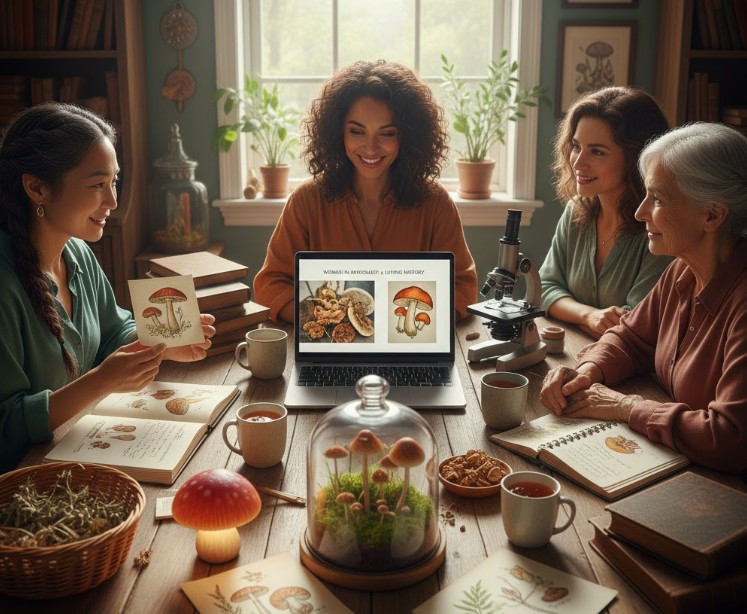
The History of Women in Mycology: We Were Always Here
People often picture a mushroom expert as a man in a lab coat, but women have studied fungi for a very long time—working from home farms, field notebooks, herbaria, and museum shelves.
This post connects women in psychedelic mycology, beginning with everyday, hands-on knowledge before moving into the story of Maria Sabina, the Victorian-era collectors, and the laboratory researchers who helped make fungi easier to identify, classify, and teach.
It also includes a few simple steps you can use to start learning mycology today, without getting lost in technical jargon.
Mycology, in plain words
Mycology is the study of fungi, and fungi include mushrooms, molds, and yeasts. If you want a simple definition, mycology is a branch of biology focused on fungi, and that focus touches food, medicine, farming, and forests.
Fungi can feed us, make bread rise, and break down fallen trees, but they can also rot crops or make people sick. That mix is why mycology matters, and why so many women ended up learning fungi in kitchens, gardens, markets, and later in labs.
Women and mushroom know-how before science had a name
Long before universities taught mycology, women gathered plants and fungi for meals and home remedies. In many places, it was women who taught children which mushrooms were food, which were poison, and which were used in rites.
This work rarely ended up in books, but it steered what families ate and how they stayed safe. When you hear “folk knowledge,” keep in mind it often came from mothers, grandmothers, midwives, cooks, and healers.
In Europe, some women learned about fungi through herbals and household guides, even when formal study was closed to them. In many Indigenous nations, women held knowledge about local species, seasons, and safe prep, and those lessons stayed alive through oral teaching.
Why women’s work with fungi was often ignored
For a long stretch, formal science was tied to institutions that barred women from membership, publishing, and paid posts. Women could collect, sketch, and write records, but a man often had to present the work or attach his name to it.
Money also mattered because field guides, microscopes, and free time cost money. When a woman also ran a home, cared for family, or worked for wages, her household work had to fit into spare hours.
Even when women did publish, later histories often skipped them. That is why it helps to read sources that name early women taxonomists, like Naming Names, and then trace their work forward.
The “mushroom ladies” of the 1800s
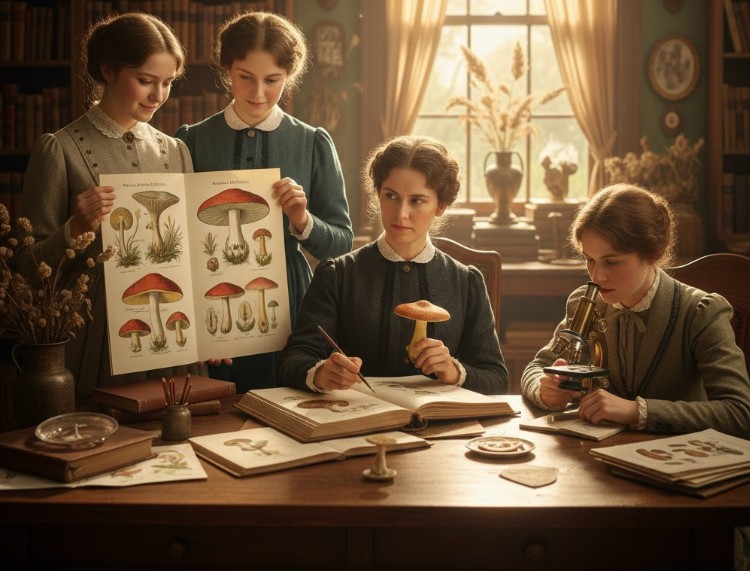
In the 1800s, many women studied fungi through careful observation and art, since sketching was seen as an acceptable hobby. Those sketches were not just pretty because they captured form, gills, color, and habitat details that helped others ID species.
Popular writing now calls them the “original mushroom ladies,” and women’s mushroom mania shares several names in one place. A closer look shows how often women did the field work and the record keeping, while formal credit went elsewhere.
Mary Elizabeth Banning
Mary Elizabeth Banning spent years painting and describing fungi in Maryland, and her work sat out of view for a long time. Today, you can see details about her manuscript and paintings through the New York State Museum.
Her story matters because it shows two truths at once: she had skill, and she faced gatekeeping. When you read her pages, you see a woman doing careful science, even while being treated like an outsider.
Anna Maria Hussey and Frances Reed
In Britain, Anna Maria Hussey and her sister Frances Reed made detailed mushroom plates that helped people learn British fungi. Their books mixed images with short text in a way that made fungi feel less mysterious to people who were new to the topic.
Their work also shows how art opened a door into science for women. When a woman could not hold a formal post, she could still teach through images, and those images lasted.
Beatrix Potter, beyond children’s books
Many people know Beatrix Potter for stories about animals, but she also studied fungal spores and sketched what she saw under a microscope. She tried to share that work through scientific circles that did not welcome women, so parts of her science path were cut short.
Her case shows that “serious” science was not only a matter of talent. Access, gatekeeping, and social rules set limits, and women had to work around them.
Women who named fungi and tracked plant disease
Some women not only paint mushrooms, but they also name species and write formal descriptions. That meant learning Latin, learning the rules of naming, and pushing their work into print even when doors were closed.
Catharina Helena Dörrien is often named as the first woman to name a fungal taxon in print. Her story is easy to trace through older records and modern summaries, and a short profile is on Catharina Dörrien.
Dörrien worked as a teacher and writer, and she published lists of plants in her region. In those lists, she also described fungi, which was rare for a woman working outside formal science circles at that time.
Marie-Anne Libert did careful work on cryptogams, a group that includes fungi and other small organisms. She is also linked to early writing on potato blight, a crop disease that later helped trigger famine in parts of Europe.
Libert’s work shows how mycology links to daily bread on the table, because a fungal disease can wipe out a harvest. A simple profile is on Marie-Anne Libert, and it gives dates and a quick summary of her plant disease work.
To make these names easier to hold in your head, here is a quick snapshot of a few women and what they did. This is not a full list, but it shows how wide women’s mycology work already was by the late 1800s.
| Name | Place | What she did |
| Mary Elizabeth Banning | Maryland, US | Painted and described many fungi in a long manuscript |
| Anna Maria Hussey | Britain | Published mushroom plates and text for the public |
| Catharina Dörrien | Germany | Wrote plant lists and named at least one fungal taxon |
| Marie-Anne Libert | Belgium | Studied cryptogams and wrote about crop disease |
Kitchen fungi: yeasts, molds, and women’s quiet science
When people say “mushrooms,” they often mean forest caps, but fungi also live in sourdough starters and cheese caves. For centuries, women kept these kitchen fungi alive by feeding starters, saving cultures, and teaching daughters and neighbors what “good” fermentation looks and smells like.
That work is chemistry, even if it was not called chemistry at the time. A baker who can fix a slow starter, or a cheesemaker who can spot bad mold early, is doing real fungal work with a sharp nose and steady hands.
Yeast also links mycology to money, because bread and beer were trade goods in many places. In many cultures, women brewed, baked, and sold fermented foods, so their fungi knowledge was also business knowledge.
In the 1900s, lab mycology grew fast because fungi became tied to medicine and farming. When scientists learned that molds could yield drugs and that fungi could destroy crops, labs had a new reason to study them.
Women entered these labs as technicians, students, and later lab heads, even if pay and credit still lagged. Today, you can read many women-led papers in plant disease, medical mycology, and fungal genetics, and the list keeps growing.
Women in psychedelics history starts with Indigenous women
When people talk about psychedelic mushrooms, they often start with a Western scientist or a magazine article. That framing misses the people who already had sacred mushroom practice long before outsiders arrived.
In many places, women were healers, singers, and ritual leaders, and their work was tied to prayer, song, and care for the sick. That is where women in psychedelics history begins, even if early Western books did not frame it that way.
The Maria Sabina story, in context
María Sabina was a Mazatec healer who became famous after outsiders came to her town and wrote about their mushroom sessions. Many retellings focus on the outsiders, but Mazatec wisdom pushes back on that and asks people to place Mazatec practice at the center.
A simple Maria Sabina story version goes like this: she shared sacred practice in a setting that had rules, and everything around her shifted fast after that. The results were not only fame, but she and her town also faced pressure, tourism, and loss of privacy.
Another telling, a priestess of mushrooms, shows how people turn her into a symbol while skipping the real person. When you read different tellings side by side, you start to see what gets left out.
Respect, consent, and cultural harm
If a tradition is sacred and tied to a people, outsiders have a duty to act with respect and restraint. That means not treating a ritual as a photo-op, not taking songs or symbols for merch, and not pressuring healers for access.
It also means listening to Indigenous voices about what harm looks like. A big part of this history is that many benefits flowed outward, while costs stayed local.
Women in psychedelics history after the 1950s
After the Maria Sabina story reached wider US media, many people rushed toward mushrooms with more hunger than care. Some were respectful, but many were not, and the rush fed a market that did not protect the Mazatec people.
A hard truth is that Western fame often rewards the writer, not the healer. That is why it helps to read more than one telling, and to listen to Indigenous writers who speak about harm, consent, and repair.
Women were also present in later psychedelic science, even if pop culture often centers on men. Women therapists, writers, and researchers pushed for safer practice, better screening, and honest talk about risk.
A modern take on women-led mushroom culture is in psychedelic feminism. It covers how women build safer spaces, how they talk about dosing, and why women’s voices matter in a field that once pushed them aside.
What it means to tell these stories with care
When we write about sacred mushrooms, we are not writing fantasy stories; we are writing about real people. That means we should avoid glamor, avoid “magic fixes,” and avoid turning a healer into a meme.
A simple rule can help: ask who benefits from the retelling. If the answer is “outsiders get content,” and the people who lived the history get nothing, then the retelling needs more care.
You can also ask what details should stay private. Many rituals have rules about who may attend, what may be filmed, and what may be shared in public, and those rules deserve respect.
If you want to learn more, learn it from people who name the limits clearly, and do not demand access. The goal is not to collect stories; the goal is to treat people well.
Mycology grew up in the 1900s, and women pushed into the field
As universities expanded, more women gained access to degrees and lab work, even if barriers remained. Women studied fungi that cause plant disease, fungi that make antibiotics, and fungi that form partnerships with plant roots.
Women also taught classes, ran herbaria, and wrote field guides that made mushrooms easier to learn. When you read modern mycology journals, you can see how wide the field is, from genetics to medical fungi.
One place to browse current topics is the Women in Mycology issue, which shows how many areas women work in today. It also shows that the story is still being written by living scientists.
Women in the lab, women in the field
Some mycologists spend days in labs, running cultures, DNA tests, and microscopes. Others spend days outside, logging what grows after rain, what grows on dead wood, and what grows in grasslands.
Women do both, and the best work often mixes both styles. You might see a scientist who can run a PCR test and also teach beginners how to spot a gilled mushroom from a look-alike.
Why illustration still matters
Even with phone cameras, illustration remains useful because it forces careful looking. A sketch can show the curve of a cap, the spacing of gills, and the texture of a stem in a way a blurry photo might miss.
This is part of why early women mattered so much. Many of them trained their eyes through art first, and those trained eyes made their science stronger.
If you want a fun read on this, fungi-mad ladies walks through how sketching and mycology grew together. It also shows that science is not only math and machines.
Women building modern mushroom culture
Today, women run mushroom farms, teach foraging classes, publish cookbooks, and lead research teams. Some focus on food mushrooms, some on soil fungi, and some on psychedelic policy and care.
Women also run circles where people talk openly about mushrooms, trauma, and healing, and those circles often pair practice with safety rules. If you want that tone, our own post on psychedelic feminism brings it into plain language.
A short note on safety
Wild mushroom picking is not a game, because one bad ID can put you in the ER. Learn from a local mycological group, use a field guide, and never eat a mushroom just because it looks right.
If you are reading about psychedelic use, keep in mind that laws differ by state and city, and mental state matters too. Talk to a licensed clinician if you have a condition or take meds, and never recklessly mix substances.
How to start learning mycology today
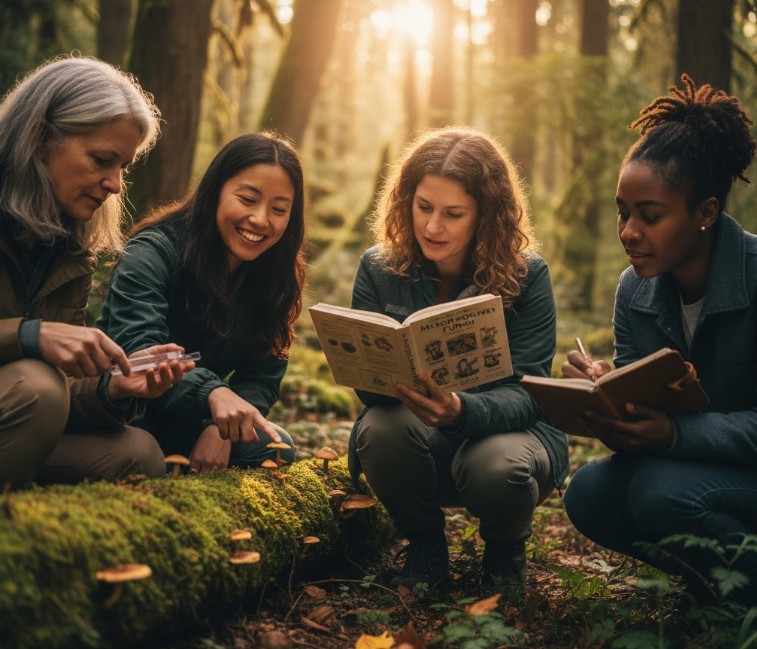
You do not need a science degree to start learning about fungi. Start with one field guide for your region, one notebook, and a habit of slowing down on walks to look at logs, leaf litter, and tree bases.
Take photos, write the date and place, and learn the basic parts: cap, stem, gills, pores, spore print, and smell. Over time, you will see patterns in when and where certain mushrooms show up.
If your focus is microdosing culture, begin with education and plain talk. Our microdosing guide covers terms, dosing basics, and safety points without a lot of jargon.
If you are brand new and nervous, our first-time tips can calm the “what if I mess this up” feeling. It also gives you simple habits, like journaling and starting low.
If you want to talk about psychedelics with family, it helps to use calm language and clear boundaries. Our post on talking about psychedelics gives examples for those talks, plus a few safety pointers.
Bringing mushroom rituals into your day
History is not only old names in old books, but it also shows us how people used fungi in real homes. A tiny daily ritual, done with care, can be a way to honor that long line of women who kept mushroom know-how alive.
If you enjoy learning about strain names and how stories travel, you may like strain name origins. It is a lighter read, but it still shows how culture affects what we call mushrooms.
Shop favorites and join Sugar Mama
If this post made you curious about bringing mushrooms into your routine, start with a form that fits your habits. Some people like capsules for simple dosing, while others prefer a square of a chocolate bar as a small treat.
If you like something fruity, try gummies for a bite-sized option, or 500 mg gummies when you want a stronger piece that you can split. Pick one form at a time, track how you feel, and keep your routine simple.
Want to share your “sugar” with others and get closer to the brand circle? Join Sugar Mama and learn how to represent the brand in a way that feels friendly and grounded.
FAQs
What is mycology?
Mycology is the study of fungi, which includes mushrooms, molds, and yeasts. It covers how fungi grow, how they interact with plants and people, and how humans use them in food and medicine.
Were women really part of early mycology?
Yes, and many women documented fungi through paintings, manuscripts, and field logs in the 1800s. Many were left out of formal credit, but their work still exists in museums and older texts.
Who was María Sabina?
María Sabina was a Mazatec healer linked to sacred mushroom ceremonies in Mexico. Many outsiders wrote about her, and that attention brought both fame and harm to her and her town.
How can I learn about mushrooms without getting hurt?
Start by learning identification from local experts and books, and do not eat any wild mushroom until you are fully sure. Take spore prints, compare look-alikes, and keep a “no tasting” rule while you learn.
How do I talk about psychedelics with family?
Start with calm language, focus on safety, and set boundaries about what you will and will not share. If you need help with wording, our talking about psychedelics post gives scripts you can borrow.
Where this story goes next
Women were never missing from mycology, even when books acted like they were. From home teaching to museum manuscripts to sacred ceremonies, women kept fungi knowledge moving from one generation to the next.
If you want to keep learning, keep asking good questions, and keep your standards high for safety and respect. And when you are ready to bring mushrooms into your own routine, our capsules, chocolate bar, gummies, and Sugar Mama pages are a good place to start.