
Transkei Mushrooms: Africa’s First Magic Mushroom Takes You Dancing With Light
If you’ve been hearing whispers about the South African magic mushroom that makes colors dance, you’re in the right place.
Transkei mushrooms hold a special spot in the psilocybin world as the first African cubensis strain to make its way into global circulation.
Mykingsgate Discovered in 2002 along South Africa’s stunning Wild Coast, this exotic strain, Mykingsgate, has earned a reputation for delivering some of the most beautiful open-eye visuals in the mushroom kingdom.
Known for their signature “dancing lights” effects and energetic body sensations, Transkei shrooms offer something genuinely different from your typical Golden Teacher experience.
In This Article:
What Makes the Transkei Strain So Special?
The Origin Story Behind South Africa’s Magic Mushroom
How to Identify African Transkei Mushrooms
Transkei Strain Effects: Why People Talk About Dancing Lights
How Potent Are Transkei Mushrooms?
Comparing Transkei to Other Popular Strains
The First African Cubensis: Why That Matters
What Science Says About Psilocybin’s Effects
Legal Status of Psilocybin Mushrooms in the United States
Growing Characteristics for Cultivators
Finding Your Sweet Spot With Transkei
Frequently Asked Questions About Transkei Mushrooms
Sharing the Experience Responsibly
Why This African Strain Deserves Its Reputation
What Makes the Transkei Strain So Special?
Let’s cut right to it. The Transkei strain stands apart from other psilocybin mushrooms for one big reason: it’s the first Psilocybe cubensis from the African continent to reach widespread cultivation and use worldwide.
Before January 2002, Africa wasn’t on the map for cubensis strains. Most popular varieties came from Central and South America, Southeast Asia, or the Southern United States.
Then someone stumbled upon these pyramid-capped beauties growing in cattle dung along the Eastern Cape coast of South Africa—and the first African cubensis changed everything.
But geography alone doesn’t make a strain famous. Transkei mushrooms earned their reputation through their distinctive effects. People describe the visual experience as unlike any other cubensis variety.
Instead of heavy closed-eye patterns, the Transkei strain delivers remarkable open-eye visuals that many describe as watching lights literally dance across their field of vision. Colors shift and swirl. Geometric patterns overlay reality. Some users report synesthesia—seeing sounds or hearing colors.
The headspace tends toward the clearer side, too. Many folks find that Transkei offers introspection without the heavy thought loops that stronger strains sometimes bring. There’s an energetic quality that makes people want to move, dance, or explore nature rather than sink into the couch.
The Origin Story Behind South Africa’s Magic Mushroom

The Transkei region sits along South Africa’s southeastern coast in what’s now called the Eastern Cape Province. Tripsitter this stretch of land—also known as the Wild Coast—features rolling green hills that meet the Indian Ocean, subtropical forests, and traditional Xhosa homelands.
Picture cattle grazing on coastal grasslands with indigenous forests nearby. That’s where the first documented Transkei specimen was collected in January 2002.
The exact discoverer remains somewhat unclear in the historical record. Some sources credit John Allen, an ethnomycologist known for documenting psilocybin strains across Asia and the Pacific. What’s well-documented is that the original collection site was precisely mapped and thoroughly photographed, giving researchers solid documentation to work from.
The Transkei region itself holds deep spiritual significance. The Xhosa and Pondo peoples have called this land home for generations. While no specific documentation links these particular mushrooms to traditional ceremonial use, the area has long held “folkloric and ethnobotanical knowledge of many fungi and spiritual practices involving plant-based medicines.”
Africa’s relationship with psychoactive mushrooms actually runs deep. The oldest known rock art depicting psychedelic mushroom use was found in Algeria, suggesting humans on this continent have worked with these fungi for thousands of years.
So when the Transkei strain emerged, it became something of a symbolic bridge—connecting modern mycology with ancient African traditions around consciousness-expanding plants and fungi.
How to Identify African Transkei Mushrooms
Transkei mushrooms look genuinely different from most other cubensis strains. Even beginners can usually spot these distinctive characteristics once they know what to look for.
The Caps
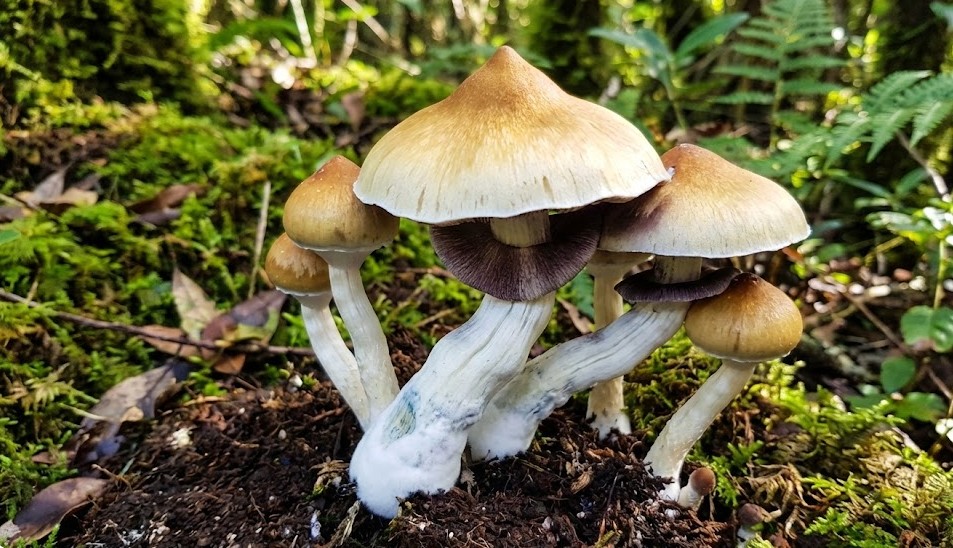
The most recognizable feature? Those pyramid-shaped caps that earned this strain its nickname: “African Pyramid.” Young Transkei mushrooms develop pointed, triangular caps that flatten out with age.
Fresh caps start bright orange-brown to golden, sometimes with hints of rust. As they mature, the color fades to pale cream—sometimes nearly white—often with purplish tones from spore deposits. This creates a beautiful white-purple-golden pattern unique to the strain.
Cap size runs small to medium, typically one to three inches across when fully developed.
The Stems
Here’s where Transkei really shows its personality. The stems grow in a characteristic gnarled, twisted, curly pattern that makes them instantly recognizable. These aren’t the straight, uniform stems you see on Golden Teachers or B+.
The stems appear crisp white Zombie Mushrooms, and tend to run thicker and meatier than some varieties. They bruise blue when handled—that oxidation reaction that indicates psilocybin content.
The Gills
Crowded gills start pale beige in young mushrooms and transition to dark purplish-brown as spores mature. Unlike some strains where gills detach easily, Transkei gills stay firmly attached to the cap.
Spore Print
Dark purple-black to purple-brown—standard for Psilocybe cubensis.
Transkei Strain Effects: Why People Talk About Dancing Lights

Now we get to the good stuff. What actually happens when you work with Transkei mushrooms?
The Visual Experience
The signature Transkei effect that everyone talks about is the open-eye visual phenomenon. Many psilocybin strains produce impressive closed-eye visuals—fractals and patterns when you shut your eyes. Transkei flips the script.
With eyes wide open, users consistently report:
- Lights appeared to dance and twinkle across their visual field
- Geometric patterns overlaying normal vision
- Colors are becoming more saturated and seeming to breathe
- Objects taking on a melting, fluid quality—”like a Dalí painting.”
- Rainbow and lace-like patterns
- Tracers following moving objects
- Kaleidoscopic effects under low light
The phrase “dancing lights” comes up so often in Transkei experience reports that it’s become the strain’s calling card.
The Body Sensations
Beyond the visuals, Transkei delivers some interesting physical effects. Despite causing what people call “mushroom yawns” (totally normal with psilocybin), this strain tends toward the energetic rather than sedating.
People report skin tingling, body vibrations, and a sense of light flowing through them. There’s often an urge to move—to dance, walk outdoors, or just flow with music. Some describe it as “sensation-enhancing,” where touch, sound, and visual input all feel amplified and interconnected.
The Mental Space
The Transkei headspace leans clearer than many potent strains. Users often describe:
- Deep euphoria and waves of giggles
- Creative thinking and novel connections
- Introspective insights without heavy confusion
- Time dilation—hours feeling like minutes
- A sense of connection and wonder
This combination of clear-headed introspection with energetic visuals makes Transkei popular for both personal exploration and social settings.
How Potent Are Transkei Mushrooms?
Let’s talk numbers. Transkei falls in the moderate-to-high potency range for cubensis strains—definitely above average, though not reaching the extreme levels of varieties like Penis Envy.
The most reliable data comes from the Psilocybin Cup competition in Spring 2022. A sample submitted under the name “Mushroom Monk” tested at:
- 0.83% psilocybin
- 0.02% psilocin
- 0.92% total tryptamines
That particular sample lands in the average range for cubensis. However, potency varies significantly between grows and individual mushrooms. Multiple sources estimate typical Transkei potency at 0.8% to 1.6% total tryptamines, which would place good specimens notably above average.
What This Means for Dosing
Because Transkei runs stronger than beginner-friendly strains like Golden Teacher, most experienced users recommend starting lower than you might with milder varieties.
Common Transkei dosing guidelines:
- Microdose: 0.1-0.3g dried
- Low dose: 0.5-1g dried
- Moderate dose: 1-2.5g dried
- Stronger experience: 2.5-3.5g dried
First-timers or those new to Transkei specifically often start around 1 to 1.5 grams to gauge personal sensitivity before exploring higher doses.
Comparing Transkei to Other Popular Strains
How does the Transkei strain stack up against the varieties you might already know?
Transkei vs. Golden Teacher
Golden Teachers offer a gentler introduction to psilocybin—more introspective, less visually intense, with an almost teaching quality to the experience. Transkei turns up the visual volume considerably while maintaining a relatively clear headspace. The energy levels differ too: Golden Teachers tend toward mellow contemplation while Transkei leans energetic and active.
Transkei vs. Penis Envy
Penis Envy strains pack the highest psilocybin concentrations of any cubensis—roughly 1.5 to 2 times stronger than average. Transkei is potent but nowhere near that level. The experiences differ, too: Penis Envy often delivers profound, sometimes overwhelming intensity. Transkei offers a more balanced ride with its signature visual flair.
Transkei vs. Other Visual Strains
Strains like Blue Meanies (Panaeolus cyanescens, not the cubensis variety) also deliver strong visuals. The difference lies in character. Transkei’s “dancing lights” phenomenon seems distinctive—that particular quality of light animation that users describe doesn’t get mentioned as often with other varieties.
The First African Cubensis: Why That Matters
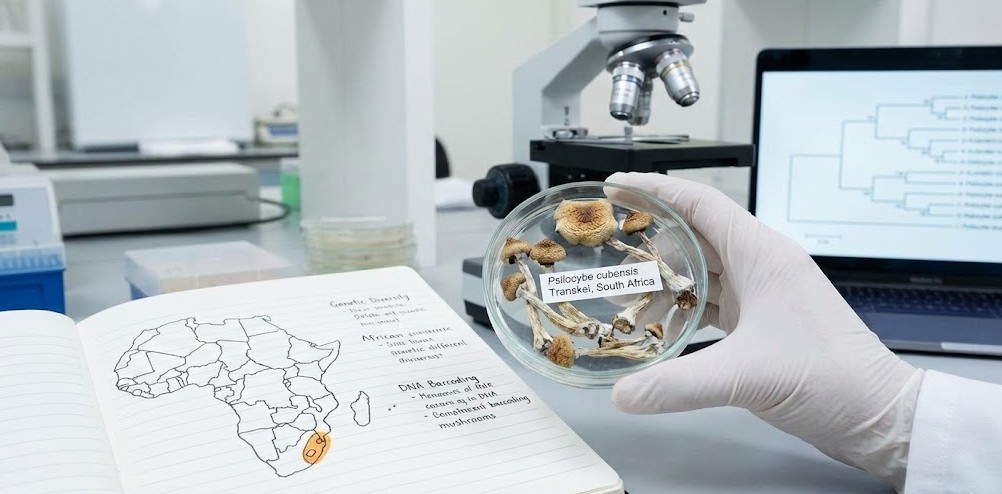
African psilocybin mushrooms getting global recognition carries weight beyond mere geography.
Most of Africa’s climate doesn’t support Psilocybe cubensis growth. The continent is largely too arid. The Transkei region’s subtropical coast—warm, humid summers with mild winters—created one of the few environments where these mushrooms could thrive naturally on the African mainland.
When the Transkei strain entered worldwide cultivation, it expanded scientific understanding of cubensis diversity and opened conversations about African contributions to entheogenic knowledge.
Research published in scientific journals continues exploring the genetic diversity of Psilocybe species. The peer-reviewed analysis of Psilocybe taxonomy shows how DNA barcoding helps scientists understand relationships between different strains and species—work that benefits from having more documented varieties to study.
The Transkei discovery also sparked new hybrid development. Cultivators crossed Transkei genetics with Penis Envy to create “Trans Envy”—a variety that combines Transkei’s visual characteristics with Penis Envy’s potency.
What Science Says About Psilocybin’s Effects
The “dancing lights” and altered perception Transkei users describe aren’t mystical imagination. Neuroscience research explains what’s happening in the brain during psilocybin experiences.
Scientists at Johns Hopkins Center for Psychedelic and Consciousness Research have conducted landmark studies on psilocybin since 2006. Their brain imaging work shows psilocybin temporarily disrupts the brain’s default mode network—the system active during normal waking consciousness and self-referential thought.
Research published in Nature in 2024 demonstrated that psilocybin causes three times greater changes in brain connectivity than a placebo. Different brain regions that don’t normally communicate start talking to each other. That cross-wiring may explain synesthesia effects—why some people report seeing sounds or sensing colors in unusual ways.
The NIH has summarized research showing these connectivity changes can persist long after the psilocybin leaves the system, potentially explaining the lasting therapeutic benefits people report.
Imperial College London’s Centre for Psychedelic Research has specifically studied psilocybin for treatment-resistant depression.
Studies at NYU Langone found that a single psilocybin dose relieved anxiety and depression in cancer patients for six months or longer.
This research focused on psilocybin generally rather than specific strains like Transkei. The active compounds—psilocybin and psilocin—work the same way regardless of source. What varies between strains is potency, ratio of compounds, and potentially other alkaloids that influence the overall character of the experience.
Legal Status of Psilocybin Mushrooms in the United States
Here’s where things get complicated. The legal landscape for psilocybin has shifted dramatically since 2019, but mushrooms remain federally prohibited.
Federal Law
Psilocybin is classified as a Schedule I controlled substance under the Controlled Substances Act. The DEA’s drug scheduling framework places it in the most restrictive category—defined as having “high potential for abuse” and “no currently accepted medical use.”
This federal classification dates to October 1970. Despite the FDA granting psilocybin “breakthrough therapy” status for treatment-resistant depression, no changes to federal scheduling have occurred.
The American Bar Association has analyzed the pathways that could reschedule psilocybin: Congressional legislation, administrative action through the FDA/DEA, or court rulings. None have progressed significantly as of late 2025.
States with Regulated Access
Three states now allow legal psilocybin use under regulated frameworks:
Oregon became the first state to legalize therapeutic psilocybin through Measure 109 in November 2020. The program opened in January 2023. Adults 21 and older can access psilocybin at licensed service centers with trained facilitators present. No diagnosis or prescription required. Approximately 8,000 people have participated in the program.
Colorado passed the Natural Medicine Health Act in November 2022. The first state-licensed session occurred in June 2025. Colorado’s approach includes both regulated healing centers AND personal use decriminalization for adults 21+. People can legally possess, grow, and share (but not sell) psilocybin in Colorado.
New Mexico signed the Medical Psilocybin Act in April 2025—the first state to legalize through legislation rather than a ballot initiative. This follows a medical model requiring diagnosed qualifying conditions like treatment-resistant depression, PTSD, or substance use disorders. Full implementation expected by late 2027.
Decriminalized Cities
Over twenty cities have decriminalized psilocybin possession, making enforcement the “lowest priority” for local police. This doesn’t make possession legal—it just reduces the likelihood of prosecution.
Key cities include:
- Denver, Colorado (first in nation, May 2019)
- Oakland and Santa Cruz, California (2019-2020)
- Seattle, Washington (the largest city to decriminalize, 2021)
- Detroit, Michigan (2021)
- Washington, D.C. (2020)
- Multiple Massachusetts cities, including Cambridge and Somerville
- Several Washington state cities, including Tacoma (2025)
Where It Remains Fully Illegal
In most states, possessing psilocybin mushrooms remains a criminal offense that can result in felony charges, significant fines, and imprisonment.
Important: Laws change rapidly. Always verify current local regulations before making any decisions. This information reflects the landscape as of November 2025, but shouldn’t substitute for legal advice.
Growing Characteristics for Cultivators
For those in jurisdictions where cultivation is permitted, Transkei offers some beginner-friendly characteristics.
Colonization
Transkei spores germinate within three to seven days and colonize substrate quickly—typically two to three weeks for full colonization. The Shroomz Store. The mycelium shows a highly rhizomorphic (stringy, rope-like) appearance on agar that many growers find visually appealing.
Fruiting Conditions
- Temperature: 70-76°F (21-24°C) for fruiting
- Humidity: 85-95%
- Air exchange: Moderate fresh air flow
- Lighting: Indirect natural or fluorescent light
Pins typically appear five to ten days after introducing fruiting conditions. Harvest usually comes five to seven days after pinning.
Difficulty Level
Most sources rate Transkei as beginner to intermediate in difficulty. The strain shows good resistance to contamination and adapts well to common substrates like brown rice flour with vermiculite (PF Tek) or grain spawn with coco coir.
One Important Note
Unlike many cubensis strains, Transkei does NOT respond well to cold shocking or ice baths during fruiting. This technique that works for other varieties can actually harm Transkei flushes.
Yields
Expect medium-sized mushrooms with thick, meaty stems. First flush typically runs most potent. Total yields fall moderately—not quite reaching Golden Teacher or Koh Samui levels, but respectable for the potency delivered.
Finding Your Sweet Spot With Transkei

If you’re exploring this exotic strain, a few approaches can help maximize the experience while respecting its potency.
Start Lower Than You Think
Transkei’s above-average strength catches some people off guard. Even experienced folks often start with 1-1.5 grams when trying a new batch for the first time.
Setting Matters
The energetic, visual nature of Transkei makes setting especially important. Many people find outdoor settings—forests, beaches, gardens—complement the strain’s character beautifully. The dancing light effects seem to shine in natural environments with dappled sunlight.
That said, cozy indoor settings work wonderfully too. Soft lighting, comfortable spaces, and good music let the visual experience unfold without distraction.
Prepare for Visuals
If open-eye visuals are new to you, know that Transkei can deliver strong effects in this department. Some people find it helpful to have both stimulating options (nature walks, music, art supplies) and calming options (blankets, quiet space) available.
Consider Microdosing
For those interested in subtle benefits without full experiences, Transkei works well at microdose levels. Those small 0.1-0.3 gram doses can offer mood and creativity support while fitting into normal daily life.
If microdosing interests you, capsules offer a convenient, precisely measured approach. Some people prefer the ritual of taking their dose with food—chocolate or gummies can make the experience tastier while providing consistent dosing.
Frequently Asked Questions About Transkei Mushrooms
What does “Transkei” mean?
Transkei refers to a region in South Africa’s Eastern Cape Province, along what’s now called the Wild Coast. The name comes from the Xhosa language and references the Kei River. The area gained the designation “Transkei” during the apartheid era as a designated Bantustan. Today, it’s integrated into South Africa proper.
Are Transkei mushrooms the most visually striking strain?
They’re certainly among the most visual cubensis varieties, particularly known for open-eye effects. Whether they’re “the most” visual is subjective—different people respond differently to various strains. What’s consistent is that bright open-eye visuals and dancing light effects get mentioned more often with Transkei than with most other cubensis.
How do Transkei compare to Golden Teachers for beginners?
Golden Teachers generally offer a gentler introduction to psilocybin. Transkei runs more potent and visually intense. Most experienced guides recommend starting with milder strains before exploring Transkei, though careful dosing (starting around 1g) can make Transkei accessible to newer explorers.
Why are Transkei mushrooms called “African Pyramids”?
The young mushroom caps develop a distinctive pointed, triangular shape that resembles pyramids, specifically compared to the Nubian Pyramids of Sudan. This unique cap formation inspired the nickname.
What’s the best way to consume Transkei mushrooms?
Common methods include eating dried mushrooms directly, brewing them into tea, grinding them into capsules, or incorporating them into food like chocolate or gummies. Tea tends to come on faster but may reduce duration slightly. Eating food can ease digestion for those with sensitive stomachs.
How long do Transkei effects last?
Typically three to six hours, depending on dose, individual metabolism, and consumption method. Onset usually occurs within 10-40 minutes. Peak effects generally happen two to three hours in.
Are Transkei mushroom spores legal?
In most U.S. states, psilocybin mushroom spores are technically legal because they don’t contain psilocybin until germinated. However, California, Georgia, and Idaho specifically prohibit spore possession. Florida criminalized spore sales in 2025. Growing the mushrooms from spores remains federally illegal.
Can I grow Transkei mushrooms at home?
Only in jurisdictions where cultivation is legal—currently Colorado (for personal use) and potentially New Mexico once their program launches. In most states, cultivation remains a felony. Always verify local laws before considering any cultivation.
Sharing the Experience Responsibly
One of the beautiful things about the psilocybin community is the willingness to share knowledge and support each other’s explorations. If Transkei mushrooms or other varieties have positively impacted your life, you might enjoy connecting with others on similar paths.
The Sugar Mama program offers a way to share products you love while earning rewards. It’s designed for those who naturally find themselves recommending wellness tools to friends and want to formalize that sharing in a meaningful way.
Whether you’re exploring microdose capsules, indulging in artisanal chocolates, or keeping things simple with gummies, having a trusted source matters for both quality and safety.
Why This African Strain Deserves Its Reputation
The Transkei strain earned its place in psilocybin culture through genuine distinctiveness—not marketing hype. That combination of dancing light visuals, clear-headed energy, and African heritage creates something truly unique in the cubensis world.
From its 2002 discovery on South Africa’s Wild Coast to its current status as one of the most requested visual strains, Transkei represents both the expanding diversity of documented psilocybin mushrooms and the growing mainstream interest in their potential.
Research continues revealing what traditional cultures always knew: these fungi have genuine value for human consciousness, healing, and wellbeing.
The legal landscape keeps shifting, too. What was unthinkable a decade ago—legal psilocybin access in American states—is now a reality in Oregon, Colorado, and New Mexico. More states watch closely as research mounts and early programs prove successful.
Whether you’re drawn to Transkei for its famous visuals, its connection to African land and culture, or simply its distinctiveness among countless cubensis varieties, this first African cubensis offers an experience worth understanding. Those dancing lights have captured imaginations for good reason.
As always, approach with respect, start with lower doses when trying any new variety, and stay informed about the laws where you live. The Transkei strain rewards patient, intentional exploration—just like the best things in life usually do.